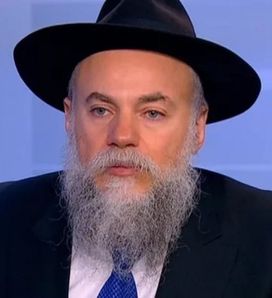
One of the goals of the Russian special military operation which began on February 24, according to President Vladimir Putin, was the denazification of Ukraine. Alexander Boroda, President of the Federation of Jewish Communities of Russia (FJCR), gave his assessment of Ukrainian neo-Nazism and the events somehow connected with military operations on the territory of this country in an interview with Interfax-Religion.
- The Jewish community of Russia has repeatedly condemned episodes of neo-Nazism in Ukraine. How can you characterize the nationalist movement of recent years?
- Firstly, not only the Jewish community of Russia condemned the surge of neo-Nazism in Ukraine. Leaders of Jewish organizations around the world not only unequivocally assessed neo-Nazi tendencies, but also issued open letters to politicians from different countries asking them to condemn these actions. Therefore, it's no secret to the international community that in recent years there has been a systematic glorification of Nazi criminals, torchlight marches and the like.
It's obvious that the problematic, complex history of the 20th century, with its many painful episodes for national consciousness, has been revised in Ukraine repeatedly. War crimes were crossed out, forgotten, and there was only a mention of the conditionally creative activities of individual leaders who advocated the nationalization of the state. If they were called heroes, then it was logical to assume that the ideology of nationalization was also set as an example. Of course, this goes against modern civilization. There are practically no mono-national states left in the world, but each country has its own system of values that unites people of different ethnic origin, different religious affiliation.
Therefore, it is difficult to understand that in Ukraine, where there is a fairly large and largely prosperous Jewish community, the glorification of criminals responsible for the death of the ancestors of those Jews is going on in parallel. It's fair to note that many Ukrainians have always opposed nationalist ideas. Many Ukrainian activists published a chronicle of events such as naming Nazi collaborators and collaborators to large institutions, erecting monuments to them, messages to religious institutions asking them to pray on the day of the UPA (an extremist organization banned in Russia - IF), as well as direct nationalist attacks. That is, all this was noticed, published, condemned by the citizens of Ukraine themselves, both within the country and in the international arena.
Nevertheless, in November 2019, Ukraine opposed the resolution proposed by Russia in the UN General Assembly on combating the glorification of Nazism and neo-Nazism. People's views on history are always different: one tends to justify, others to stigmatize, someone chooses the middle, and there are hundreds, if not thousands, of semitones of opinions between these values. But one way or another, there are facts that cannot be ignored: the participation of the UPA in punitive actions concerned not only Jews, but also other ethnic minorities. For example, the Volyn massacre, which destroyed fifty thousand Polish civilians.
I believe with a high degree of confidence that the majority of Ukrainian citizens do not support the ideology that grew up on criminal episodes of history.
- It's known that Israel have organized a mass evacuation of Jews wishing to leave Ukraine these days. Do all of them leave or only a small part, do you have data on this?
- The Jewish community of Russia doesn't have separate channels of information. Based on official sources, we see that there are a lot of refugees, and these are not only Jews or descendants of Jews who have the right to repatriation. Now everyone is trying to make the evacuation of civilians as safe as possible. And I can say that Jewish refugees go not only to Israel, they also move to Russia and seek help from our communities.
- How are the premises of Ukrainian synagogues used these days? Just for prayer, or did they find other uses, in particular to shelter people from shells?
- According to the publications, synagogues work in an enhanced humanitarian regime and act as points of charitable assistance, provide support to those in need. And this is certainly correct. Religious organizations must now strengthen their direct mission - to provide spiritual and material support, to be open to everyone, but not to make political slogans and appeals. And in no case contribute to the separation between people.
- What is happening now in synagogues in the south of Russia? What is the main need of refugees? How many of them have been covered by the humanitarian programs of FJCR?
- The work of the communities of the southern regions of Russia, such as Rostov, Crimea, Sochi, Krasnodar, is very indicative. The rabbis noted that a lot of people came to the synagogues on the last Sabbath. There is a sense of cohesion and a desire not to stand aside, all refugees are being helped, and local residents actively offer their participation both as help and financially. This, of course, speaks volumes and gives confidence. I would like to emphasize once again that it's very important to be close to your neighbors and focus on good deeds in this situation.
- Can the disconnection of some Russian banks from SWIFT affect the scale of charitable and other programs of the Federation of Jewish Communities? Does your organization have some kind of insurance against such situations?
- Disconnecting Russia from the SWIFT system will affect the activities of many institutions, not only religious ones. Economic sanctions are targeted, but their indirect impact will be experienced by the majority of Russian residents. Of course, the state will do its best to mitigate the economic pressure. But adjustments in the work of many organizations will occur, humanitarian and non-profit organizations won't be an exception.
- How would you comment on the statement of the Ukrainian side about the alleged missile strike on Babi Yar, which, as it turned out, did not happen?
- This is a very vivid example of the fact that it's impossible in any case to immediately respond to any statements. It's impossible to succumb to information hysteria. The pandemic has played a very cruel joke. People are so used to existing in the virtual world that now they completely forget that an event is not a message onFacebookorTwitter, it must have factual confirmation, objective evidence. At the moment, media representatives from different countries confirm that the memorial is not damaged. But, unfortunately, even the reports of publications with international authority can be unreliable. Therefore, before making a conclusion, it's very important to read not only the title, but also the description, and try to analyze the event independently on the basis of facts.
I also hope that journalists and bloggers will show more respect for history and that multiple speculations on the Jewish topic will stop.
- What do you think about the latest manifestations of Russophobia in Europe?
- There is no justification or explanation for this, it's unacceptable at any level. The fact that the owner of a restaurant in Germany was branded in the public space after his announcement of the rejection of people with a Russian passport indicates a clear marginal component of such actions. Both public organizations and social networks should now work to strengthen horizontal ties, but not to popularize open hostility. A few days ago, a video appeared on social networks, from which it follows that, again, in Germany, the windows were broken and the Russian store was doused with paint. I really want to believe that this is not true. Because it was with Kristallnacht, the night of broken glasses, that the triumphant and long-term march of Nazism began.

Interfax-relegion.com Editorial Team
Sean Phillips
I’m Sean Phillips, a writer and editor covering and its impact on daily life. I focus on making complex topics clear and accessible, and I’m committed to providing accurate, thoughtful reporting. My goal is to bring insight and clarity to every story I work on.
0 Comment