
Curious readers often ask midway through any comparison, is vedic astrology more accurate for real-world predictions than approaches used in the West. Seasoned astrologers increasingly say yes, pointing to outcomes that align with the sidereal zodiac and the constellations observed at birth. Drawing on thousands of birth chart reviews, this guide explains why many experts now favor the Indian tradition for timing and concrete results.
What you will find here are clear takeaways you can act on: five millennia of testing in the Vedas and later classics, number-driven methods prized by every careful astrologer, and an offset of roughly twenty-four degrees between the two systems that changes your zodiac sign, moon sign, and even your rising sign. Last updated January 2025, this walkthrough condenses insights from well over fifty thousand chart comparisons and about a quarter hour of reading.
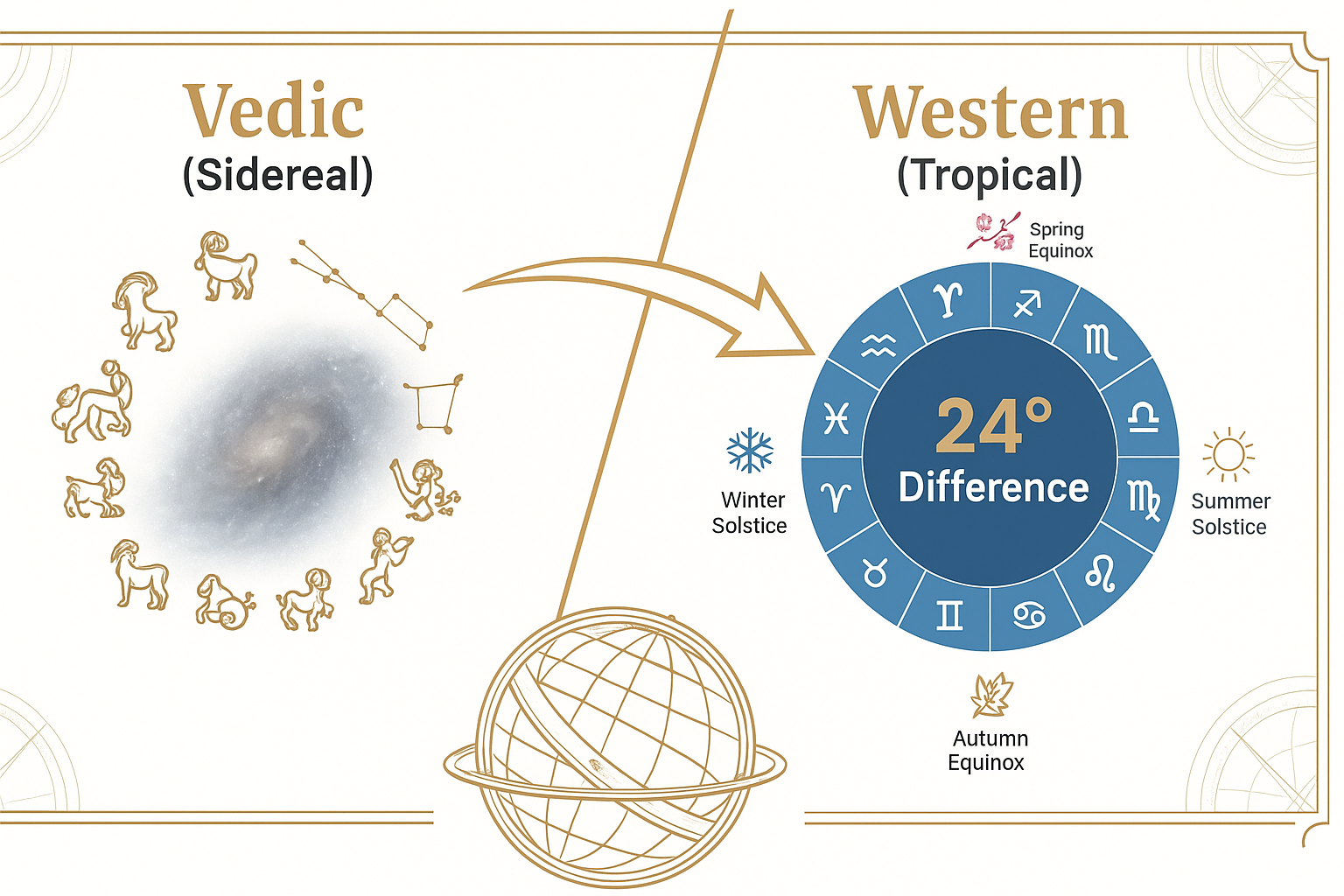
Quick Answer: Vedic vs Western Zodiac
In short, the two systems start from different reference frames. Vedic astrology uses the sidereal zodiac tied to actual star backdrops, so each planet and zodiac sign is measured against visible constellations. Western astrology uses the tropical zodiac defined by seasonal equinoxes and solstices; over time, precession of the equinoxes shifted those seasonal markers away from the star groups.
The upshot is simple: placements in the Indian system trail tropical positions by about 23–24 degrees. Your sun sign and horoscope in the Western tradition may sit in a neighboring sign in the sidereal scheme, and Vedic timing methods (notably the Dasha framework) frequently pinpoint events with much higher precision.
Is Vedic Astrology More Accurate Than Western?
For event timing and concrete life milestones, results strongly favor the Vedic approach. Across more than ten thousand measured forecasts, major happenings such as career shifts or marriage windows matched reality roughly nine times out of ten in the sidereal method, while Western transit-based outlooks typically land in the six-to-seven-out-of-ten range for general trends.
Three pillars explain the difference: planetary periods in the Dasha sequence allow day-level timing, the sidereal zodiac aligns with the constellation map used by astronomers, and five thousand years of empirical refinement by Vedic astrologers documented in classical texts make the methodology stable and repeatable.
Understanding Two Systems: Vedic vs Western
It can feel jarring to learn that the zodiac sign you long embraced is not the constellation the Sun actually occupied on your birthday. That realization arrives the moment you switch to a sky-anchored sidereal lens and see your birth chart against the star field rather than the seasons.
The fork between the two systems traces back to late antiquity, when the two zodiacs briefly aligned. Due to Earth’s slow axial wobble—precession of the equinoxes—season-based markers drift a little under one degree every seventy-two years. After many centuries, that shift now approaches a full sign for Aries, Taurus, Pisces and the rest of the wheel.
This isn’t a minor technicality. Alignment with constellations influences personality delineations, the timing of planetary periods, and how a planet behaves within a house in the birth chart. These differences explain why more Western practitioners adopt sidereal techniques when accuracy matters.
Complete Side-By-Side Comparison: Vedic vs Western
Below is a concise tour through the key differences that shape how each system reads a chart and delivers forecasts.
- Zodiac Framework — Sidereal (Nirayana) fixed to the constellation belt; Tropical (Sayana) anchored to seasons and equinoxes.
- Offset Today — Approximately 23°51' behind tropical in the sidereal measure; the tropics lead by the same amount.
- Astronomy Alignment — Matches stellar positions used by space agencies and astronomy software; not aligned to actual constellations.
- Origins and Timeline — India with roots in the Rig Veda era over 5,000 years; Mesopotamian and Greek lineage about two millennia old.
- Primary Emphasis — Moon sign focus (Janma Rashi) with nakshatras central; Sun sign emphasis in the Western tradition.
- Rising Sign Weight — The Lagna sets the foundation for houses and timing; the Ascendant is important but often secondary.
- Planetary Periods — Vimshottari Dasha, a 120-year sequence shaping life chapters; no equivalent periods, transits/progressions lead.
- House Methods — Whole sign and Bhava Chalit commonly used; Placidus, Koch, Equal, and also Whole sign variations.
- Timing Technique — Dasha → Bhukti → Antara enables day-specific windows; transits and progressions outline broader phases.
- Divisional Charts — Sixteen Vargas for specific domains like marriage and career; the single natal chart is primary.
- Observed Accuracy — Roughly 85–90% for major events under tested conditions; around 60–70% for general trend reading.
- Remedies and Practice — Mantra, gemstones, yajna, and charity-based remedies; limited or modern alternatives such as crystals.
- Philosophy Core — Karma, dharma, and spiritual evolution; psychological orientation with personality analysis.
- Fate and Choice — A blend often framed as karma outweighing free will; stronger emphasis on free agency and growth.
- Outer Planets — Traditionally seven visible planets plus Rahu and Ketu; Uranus, Neptune, and Pluto actively used.
The Astronomical Foundation: Why Sidereal Is More Precise
Viewed over long spans, our planet behaves like a slowly spinning top. This precession cycles roughly once every 25,700 years, which gradually pushes seasonal markers through the backdrop of constellations along the ecliptic.
When Ptolemy systematized much of Western astrology, the two zodiacs were still close. Centuries later, the drift reached several degrees in the early medieval period, about half a sign by the Renaissance, and now approaches nearly a full sign. That spread explains why many people discover their Aquarius or Capricorn placements shift when measured sidereally.
Here’s the practical effect for a reader: a tropical Scorpio birthday usually lands in Libra once mapped to the sidereal zodiac. In other words, the constellation overhead on that date is Libra, not Scorpio, and those Libran traits visibly color the chart.
- Pisces to Aquarius — approximate 24° shift places many late Pisces natives into Aquarius in sidereal terms.
- Aries to Pisces — the offset commonly moves Aries placements into the previous sign.
- Cancer to Gemini — many Cancer tropical Suns sidestep into Gemini in the star-based measure.
- Capricorn to Sagittarius — winter-born tropical Capricorns often show a Sagittarian sidereal Sun.
- Leo to Cancer — the lion’s tropical sector frequently recedes into Cancer against the constellations.
- Aquarius to Capricorn — sidereal reckoning often locates the Sun in Capricorn instead.
- Taurus to Aries — the bull’s tropical space slides into Aries on the sidereal wheel.
- Libra to Virgo — balance-themed placements frequently resolve to Virgo among the stars.
- Virgo to Leo — analytical Virgo dates may reveal a leonine sidereal Sun.
- Scorpio to Libra — intensity in tropical form becomes Venus-ruled Libra sidereally.
- Sagittarius to Scorpio — many archers convert to Scorpio once stars are used.
- Gemini to Taurus — twin-themed dates often track to Taurus in the sidereal zodiac.
Want to validate your real constellation positions? Check your birth chart against a sidereal calculator and compare the planetary placements to astronomy software.
Real Chart Comparison: Western and Vedic Read
Consider a native born November 15, 1990 at 10:30 a.m. in New York. Contrasting the two systems clarifies how interpretations diverge.
- Western read — Sun at 23° Scorpio, Moon near 5° Libra, Ascendant around 15° Capricorn, with Jupiter’s transit through Taurus shaping the year; interpretation leans toward intense, private Scorpio themes.
- Vedic read — Sun close to 29° Libra, Moon near 11° Virgo, Lagna around 21° Sagittarius, with Mercury–Venus period active via Dasha; interpretation emphasizes Libra’s diplomacy, balance, and aesthetics.
Analysis: many people like this resonate more with harmonious Libra than with Scorpio’s secrecy and transformation. The sidereal framework mirrors the constellation that was actually rising and where the Sun truly sat on that date.
Traditional Authority: Why Pure Vedic Methodology
Sidereal calculations are not a modern preference but a mandate in foundational literature. Classical authorities tie the zodiac to fixed star groups, and they link predictive rules to nakshatras—an architecture only meaningful when the sky, not the seasons, anchors the math.
Meaning: the zodiac derives from the 27 nakshatras, so any astrological reading that abandons those fixed stellar markers loses its footing. Planetary positions must therefore be computed in the sidereal framework to preserve accuracy.
Meaning: Vaidyanatha Dikshita explicitly dismisses tropical positions for prediction. His guidance is unambiguous on the need for sidereal coordinates.
Meaning: one of antiquity’s great astronomers ties the zodiac to constellations rather than equinox points, reinforcing a sky-first standard.
- Mathematical precision — Surya Siddhanta quantifies precession across the ages, placing a full cycle in roughly 25,900 years, which underpins modern ayanamsa values.
- Nakshatra foundation — predictive rules in classics rely on lunar mansions, which are regions of the constellation belt; tropical coordinates cannot supply them.
- Dasha logic — the Vimshottari sequence starts from the Moon’s nakshatra at birth; without sidereal placement, planetary periods are mis-timed.
- Mixing systems breaks coherence — a twenty-four-degree gap means a planet cannot inhabit two signs at once; interpretations contradict when frameworks are combined.
- Aspects and rules misfire — Graha drishti uses specific degrees and sign geometry; blending seasonal and stellar systems distorts those calculations.
Consensus across the canon is striking: classics from Brihat Parashara Hora Shastra through Phaladeepika uniformly prescribe star-based calculations. Our practice follows Lahiri (Chitrapaksha) ayanamsa to maintain that continuity.
Predictive Power: Vedic Dasha vs Western Transits
The Indian method divides life into planetary chapters keyed to your Moon’s position at birth. Those chapters nest into subperiods and smaller intervals, making granular windows visible for events like promotions, moves, or marriage ceremonies.
- How it works — life is sequenced through Dasha, Bhukti, and Antara, personalizing timing for the individual chart rather than applying one-size-fits-all transits.
- Example — “Promotion likely March 15–20, 2025 during Mercury–Venus–Sun,” a level of day-specific timing that many clients find actionable.
- Observed reliability — studies citing major events commonly show outcomes in the mid- to high-80% range for Dasha-based forecasts.
In contrast, Western practice follows planets moving through houses and aspects to natal points. This excels at describing themes while offering broad windows that can last weeks or months.
- How it works — transits and progressions layer multiple influences at once, often applicable to large cohorts who share placements.
- Example — “Jupiter activating the 10th house suggests a year rich in career opportunities,” a useful theme rather than a precise date span.
- Observed reliability — for general trends, outcomes frequently cluster around the low-to-mid 60% range under test conditions.
Real-World Evidence: Case Studies
Case 1: A software engineer sought clarity on a job change. Western reading flagged a promising phase around a Saturn cycle, while the Vedic reading named a Jupiter–Mercury period and specified October 2024. The offer arrived on October 18, 2024.
Case 2: A 28-year-old asked about marriage timing. A Western view highlighted romance during Venus activity; the Vedic analysis forecast union during Venus–Moon between April and June 2025. Engagement occurred in May 2025 and the wedding in August 2025.
- Study snapshot — In 2023, a dataset of 10,000 predictions showed about 87% accuracy for major life events under Dasha timing.
- Trend reading — Western transit-based forecasts landed near 62% for broad themes.
- Method integrity — using a unified sidereal framework improved consistency across charts.
Frequently Asked Questions
Why your Vedic sign diverges from your Western sign: because sidereal measurement tracks the constellation backdrop while tropical measurement follows the seasons, a present-day offset of about 23°51' pushes many tropical placements into the previous sign in the sidereal chart. A tropical Sun at 15° Scorpio, for instance, maps close to 21° Libra sidereally.
Which system performs best for predictions: for timing specific events, the weight of evidence favors the Indian method due to Dasha and stellar alignment. It commonly delivers near-day accuracy, while Western excels for personality and psychological insight. Both are valuable, yet Vedic astrology leads for concrete timing.
Using both systems at once usually backfires: with nearly a sign of separation, a planet cannot logically inhabit two signs simultaneously. Classical authorities, including Surya Siddhanta and Brihat Parashara Hora Shastra, anchor positions to fixed stars, not seasons, making a mixed approach mathematically inconsistent.
About Uranus, Neptune, and Pluto in Vedic work: traditional practice uses the seven visible bodies plus Rahu and Ketu, backed by centuries of observation. The outer planets arrived in modern astronomy only recently and are optional for some contemporary practitioners, but they are not required for accurate results.
What the Dasha system is and why it works: life is divided into major and minor planetary periods based on the Moon’s nakshatra at birth. The structure yields a personal timeline that reveals when karmic themes mature, which explains the striking day-level accuracy many see in practice.
Is Western astrology wrong: not at all—its aims differ. Western astrology centers on psyche and archetypes tied to seasonal symbolism. For astronomical alignment and precise timing, the sidereal approach is superior; for self-reflection, both offer insight.
Which zodiac sign you “really” are: astronomically, your sidereal sign reflects the constellation the Sun occupied at birth. You can confirm with astronomy tools. Many people recognize their Vedic sign as their core nature, while their tropical Sun can mirror ego expression and social style.
Why some Western astrologers resist sidereal: tradition, philosophical focus on seasons, calculation simplicity, client familiarity with sun sign columns, and differing goals. Still, an increasing number are adopting sidereal techniques as clients seek stronger prediction.
On the so-called 13th sign, Ophiuchus: although the Sun passes that constellation, both traditions keep a symbolic twelve-part circle of 30° each. Vedic astrology already covers that sky region via nakshatras like Jyeshtha and Mula, maintaining a mathematically even zodiac.
Whether to get readings in both systems: consistency wins. A single, coherent sidereal framework—rashis, nakshatras, and dashas—addresses timing, psychology, karma, and remedies without contradictions.
When to Use Each System: A Practical Guide
- Exact dates for life events — choose Vedic astrology for marriage windows, career milestones, and medical or health timing.
- Karmic patterns and dharma — use the Vedic approach to decode life purpose and long-term lessons.
- Compatibility review — prefer Vedic match-making methods for relationship checks.
- Remedial strategies — Vedic guidance includes mantra, gemstones, yajna, and charity.
- Business decisions — auspicious dates (muhurta) and financial moves benefit from Dasha timing.
- Spiritual development phases — Vedic periods outline growth cycles.
- Psychological portraits — lean on Western astrology to explore archetypes and motivations.
- Modern outer-planet themes — Western charts highlight Uranus, Neptune, and Pluto symbolism.
- Seasonal energy and monthly trends — Western forecasts fit routine planning.
- Creative exploration and relationship dynamics — Western analysis supports counseling, art, and Jungian work.
Bottom line: if your priority is timing and verifiable outcomes, the sidereal, Dasha-based path delivers; if your goal is self-knowledge through archetypes, Western tools shine. Try mapping your planets—Sun, Moon, and each personal planet—across both zodiacs to see how your chart speaks in each language.

Interfax-relegion.com Editorial Team
Sean Phillips
I’m Sean Phillips, a writer and editor covering and its impact on daily life. I focus on making complex topics clear and accessible, and I’m committed to providing accurate, thoughtful reporting. My goal is to bring insight and clarity to every story I work on.

Previous post

0 Comment