
Newcomers often hear about tropical and sidereal approaches without realizing they map the sky differently. This overview breaks down how each zodiac frames your chart and why both systems matter to an astrologer.
How Your Zodiac Sign Is Determined in Western Astrology
For many people raised on Western astrology, “I’m Aries” simply means their Sun was said to occupy that zodiac sign on the date of birth. In practice, this refers to the Sun’s position relative to a constellation at that moment, and most folks use that one marker—the Sun sign—when discussing their zodiac identity.
Why Some People Claim Astrology Misses the Mark
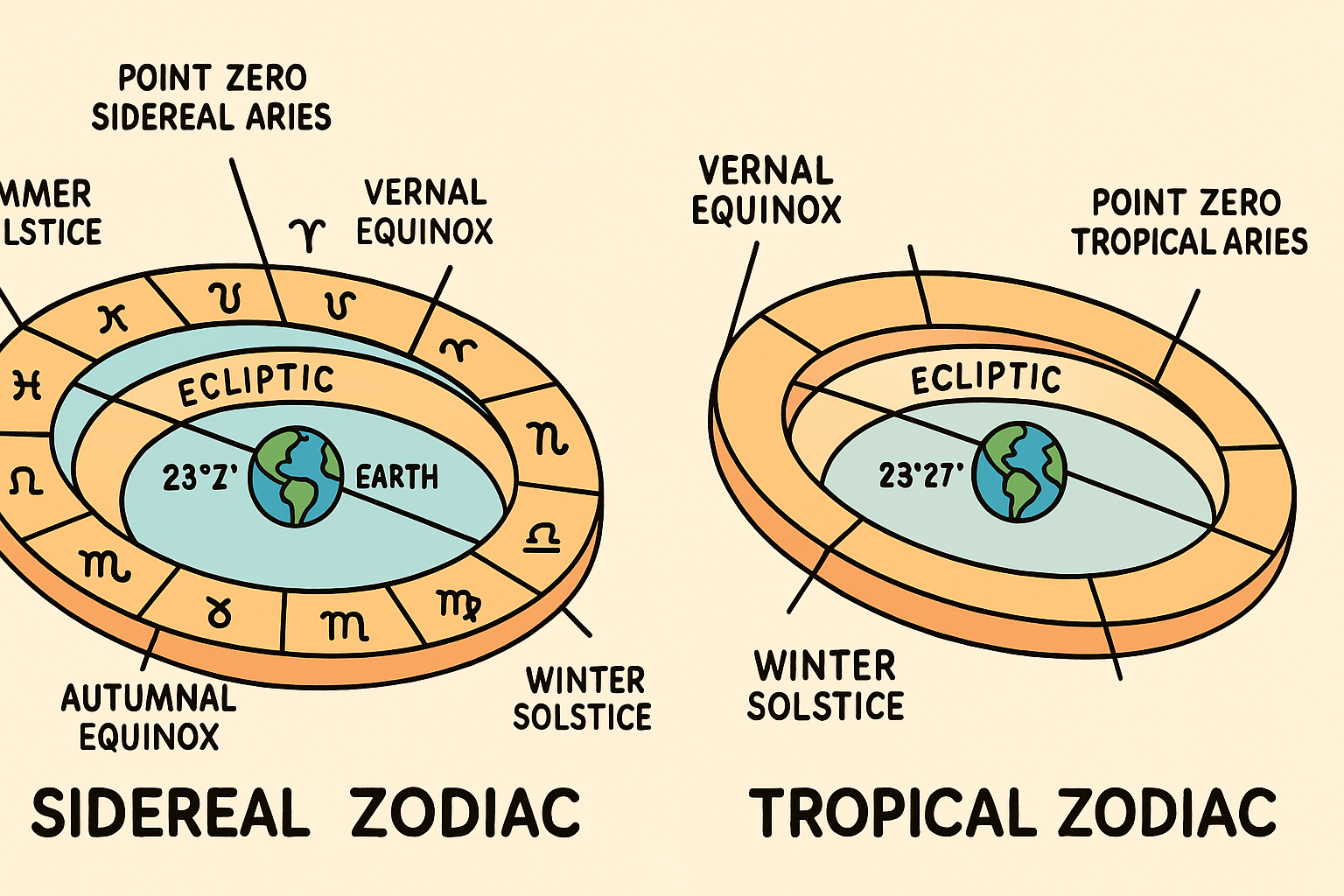
It’s common to hear skeptics insist, “I’m labeled Aries, yet astronomically the Sun sat in Pisces that day—so the whole thing fails.” A well-known science communicator, Bill Nye, even shared a brief video along these lines. The confusion usually comes from mixing two measurement systems in a sidereal vs tropical comparison.
What the Tropical Zodiac Measures
Most Western astrology uses the tropical zodiac, a framework anchored to seasonal markers established millennia ago, rather than to the current star backdrop. As ideas moved from ancient India through Persia into the Mediterranean world, debates about fate and free will shaped how this calendar-based model took hold in Western astrology.
Earth’s Wobble and Equinox Precession
Because our planet slowly precesses, the backdrop of constellations slides over long spans of time; the Sun’s apparent location on a given date can shift by nearly a sign—around 24 degrees—since antiquity. In my own case, a tropical chart places the Sun in Aries, while a sidereal chart, which accounts for equinox precession, places it in Pisces. This happens because the sidereal zodiac tracks the sky’s drift instead of freezing it at an ancient reference point.

Sidereal Astrology and Its Claimed Precision
Ancient Vedic astrology (Jyotish) developed methods that effectively correct for this long-term drift, aligning charts with the fixed stars rather than seasonal points. Achieving that requires either a vast archive of careful observations spanning millennia or sophisticated modeling—evidence that the tradition likely predates the period, roughly 500 BCE, when it was formally recorded.
Using Both Systems Side by Side
Because the sidereal and tropical frameworks answer different questions, each can be internally consistent. For example, my Sun reads Pisces in a sidereal chart but I still resonate with Aries traits, possibly because my Moon lands in Aries in both Vedic astrology and Western astrology. And remember: beyond the Sun sign, your chart also includes a Moon sign, Mercury’s placement, and the Ascendant (rising) that sets the stage for the entire wheel.

Astrology’s Breadth: More Than Newspaper Horoscopes
Real astrology is far richer than casual columns; it blends interpretive art with systematic analysis. In the modern West, a strong emphasis on personal choice—shaped by Enlightenment-era critiques and a tilt toward material science—spawned skepticism. In India, by contrast, scientific inquiry and Vedic astrology often coexist without friction.
Where Science and Spirit Can Intersect
Part of the appeal for me is the balance: reliable patterns you can test alongside a recognition that not everything is visible. This middle path leaves room for observation and mystery to inform the same practice.
Continue Learning: Introduction to Vedic Astrology
If the contrast between tropical and sidereal models sparked your curiosity, you’ll enjoy exploring how Vedic astrology reads timing, temperament, and life themes through a different lens. A deeper look can transform how you think about your chart.
Discover Ancient Wisdom, Transform Your Life
Ready to go beyond basics? Study the foundations, compare methods, and see which lens—seasonal or star-based—speaks most clearly to you.
- How old is Jyotish? Estimates vary. A cautious view puts formal compilation no later than about 500 BCE, while Indian sources often cite at least five millennia of history, supported by data on equinox precession—suggesting origins as early as 3500 BCE or even earlier.

Interfax-relegion.com Editorial Team
Sean Phillips
I’m Sean Phillips, a writer and editor covering and its impact on daily life. I focus on making complex topics clear and accessible, and I’m committed to providing accurate, thoughtful reporting. My goal is to bring insight and clarity to every story I work on.

Next post
0 Comment