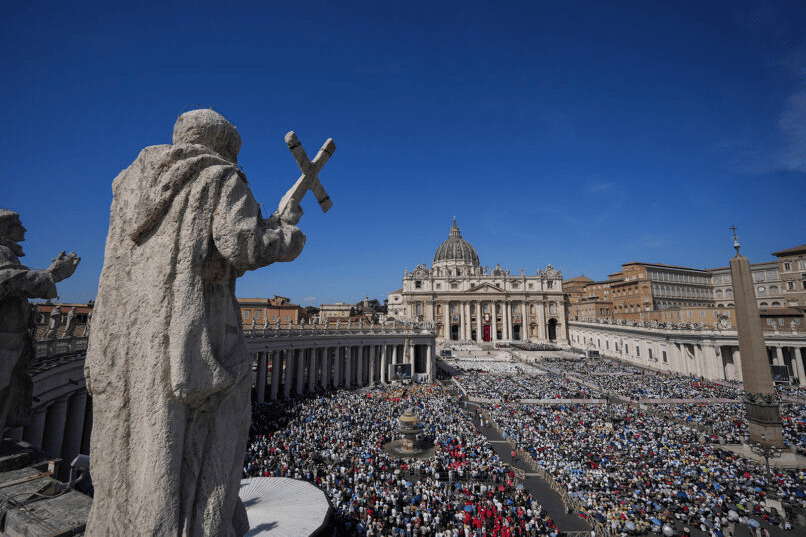
VATICAN CITY — Shortly before embarking on his first apostolic journey to Turkey and Lebanon in November, Pope Leo XIV approved a series of reforms to the Vatican’s labor regulations. The changes reflect a recognition that the makeup of the Church’s workforce has shifted dramatically and that long-standing employment practices no longer match present-day realities.
At the center of the reform is a revised document governing personnel of the Roman Curia — the administrative body that supports the pope’s governance of the Catholic Church. Released on Nov. 24, the updated rules simplify recruitment procedures, define baseline qualifications for employees, and reinforce restrictions against nepotism. Together, these measures are designed to accommodate a growing presence of lay professionals within Vatican offices.
From Clerical Privilege to Modern Employment Challenges
For centuries, employment within the Vatican was largely the domain of clergy and was widely viewed as an honor tied to ecclesiastical service. In recent decades, however, changing social conditions and persistent financial pressures have made curial positions less attractive.
Although Vatican employment still offers certain benefits — such as tax exemptions and access to subsidized services like the Vatican pharmacy and grocery store — compensation packages have struggled to keep pace with those available in Italy’s public and private sectors. As a result, recruiting skilled lay professionals has become increasingly difficult.
At the same time, many potential candidates lack familiarity with the unique mission of the Vatican, which operates not as a profit-driven institution but as a religious entity with distinct priorities.
Balancing Mission and Management
That tension was highlighted by Bishop Juan Ignacio Arrieta Ochoa de Chinchetru, secretary of the Pontifical Commission for Legislative Texts, during a briefing with Vatican journalists hosted by the Pontifical University of the Holy Cross.
Arrieta emphasized that professionals entering Vatican service must adjust their expectations. “This economy is not structured to maximize revenue,” he explained, noting that financial losses may be tolerated when they serve broader ecclesial goals rather than conventional business metrics.
He added that the Office of Labor of the Apostolic See continually reviews employment rules, including benefits and social security provisions, to keep pace with evolving needs.
New Oversight and Administrative Flexibility
Under the revised framework, responsibility for hiring is placed under the Vatican’s Secretariat for the Economy, while the Office of Labor gains greater autonomy to handle employment matters without being constrained by the Curia’s complex hierarchical structure.
These changes build upon earlier reforms, most notably Praedicate Evangelium, the apostolic constitution issued by Pope Francis in 2022 that reorganized the Curia and emphasized missionary purpose over institutional self-preservation.
A Shift in Leadership Style
While Leo XIV’s reforms follow Francis’ structural overhaul, they signal a noticeable change in tone. Francis was known for publicly criticizing curial officials, particularly in his annual Christmas addresses, where he warned against careerism, hypocrisy, and isolation from real-world concerns.
Leo, by contrast, appears to favor quieter institutional adjustments aimed at improving accountability and efficiency. In his first meeting with Vatican employees after his election in May, he invoked the saying, “Popes come and go, the Curia remains,” expressing gratitude for staff members’ ongoing service.
Concrete Gestures Toward Workers
That emphasis on appreciation was reinforced through specific actions. Leo reinstated a long-standing tradition of granting Vatican employees a €500 bonus for their work during the conclave. In August, he approved new paternity leave provisions and expanded support for families caring for children with disabilities.
The revised labor regulations are expected to make similar policy updates easier to implement in the future.
The Growing Role of Lay Leadership
The increasing presence of lay employees within the Curia is driven in part by a decline in priestly vocations. With fewer ordained clergy available, Vatican offices face intensified competition for qualified personnel.
“Recruitment has become a serious challenge,” Arrieta acknowledged, noting that bishops are often reluctant to release their most capable priests for curial service, given pastoral needs in their dioceses.
Under Pope Francis, the Vatican began actively promoting lay leadership, especially among women. Pope Leo XIV has accelerated this trajectory. On Nov. 21, he approved amendments to the Fundamental Law of Vatican City State allowing laypeople to head Vatican commissions.
One prominent example is Sister Raffaella Petrini, who currently serves as the first lay president of both the Pontifical Commission for Vatican City State and the Governorate — an appointment initially made by Francis in March 2025.
Unresolved Structural Pressures
Despite the new labor rules, deeper challenges remain. The Vatican pension fund faces a projected deficit estimated between €600 million and €800 million, raising long-term concerns about financial sustainability.
In an open letter issued late last year, the Association of Vatican Lay Workers — the closest equivalent to a labor union within the Vatican — criticized a lack of transparency regarding pension management and called for clearer communication.
Adding to institutional pressure, dozens of Vatican Museums employees filed a rare lawsuit alleging unsafe working conditions, chronic understaffing, and excessive workloads. The museums represent one of the Vatican’s most important sources of revenue, intensifying scrutiny of labor practices.
Cautious Optimism, Uncertain Outcomes
In a statement released in May, the Vatican workers association described its meeting with Pope Leo XIV as a positive signal and “an encouragement to continue dialogue and build bridges.”
Whether those early gestures and regulatory reforms will develop into a comprehensive strategy capable of addressing the Vatican’s intertwined financial and personnel challenges remains an open question — one that Leo XIV’s pontificate will increasingly be judged upon.

Interfax-relegion.com Editorial Team
Sean Phillips
I’m Sean Phillips, a writer and editor covering and its impact on daily life. I focus on making complex topics clear and accessible, and I’m committed to providing accurate, thoughtful reporting. My goal is to bring insight and clarity to every story I work on.
0 Comment